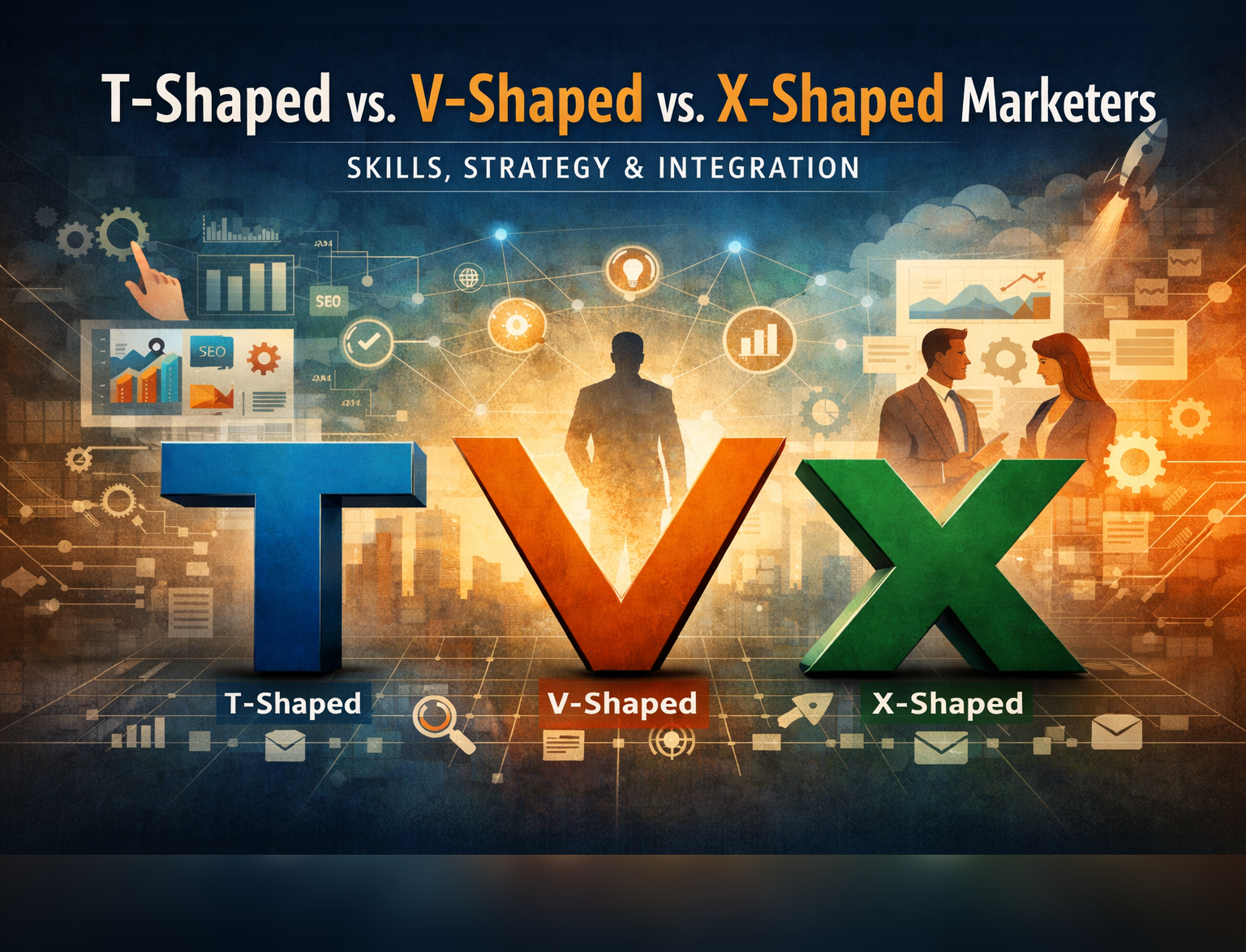
For more than a decade, marketing professionals have been described through letters of the alphabet. The T-shaped marketer became a symbol of balanced competence. The V-shaped marketer emerged as a response to increasing technical depth requirements. More recently, the X-shaped marketer entered the conversation, emphasizing cross-functional leadership and connective intelligence.
But behind these letters lies a deeper question:
Are these shapes truly meaningful frameworks — or simply metaphors that oversimplify modern marketing complexity?
To answer that, we need to move beyond the alphabet and into the architecture of capability itself.
The Origin of the “Shape” Metaphor
The idea of representing professional skills as geometric shapes is not uniquely marketing-driven. The T-shaped concept originally described professionals who combine broad understanding across disciplines with deep expertise in at least one area. In marketing, the metaphor gained popularity as digital transformation fragmented the discipline into SEO, paid media, CRM, automation, analytics, UX, content, and more.
Suddenly, marketers could no longer succeed as pure generalists. Nor could they operate effectively as isolated specialists.
The shape metaphor became a shortcut to describe a balanced response.
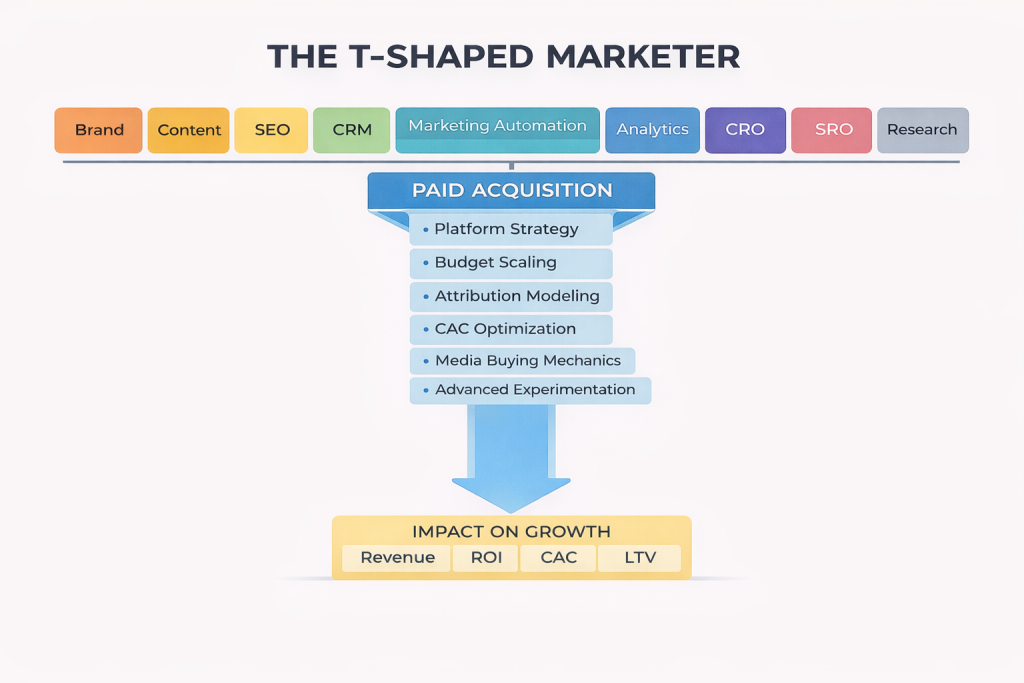
The T-Shaped Marketer: Breadth with a Core Depth
The classic T-shape has two components:
- The horizontal bar represents broad knowledge across multiple marketing disciplines.
- The vertical pillar represents deep expertise in one area.
A T-shaped marketer might understand how SEO influences content strategy, how paid media integrates with CRM automation, and how analytics drives optimization — while being deeply specialized in performance marketing, for example.
Why the T-Shaped Became Dominant
The rise of T-shaped thinking coincided with three structural shifts:
- Digital channel proliferation
- Data-driven decision making
- Cross-functional campaign integration
Organizations realized that isolated specialists struggled to collaborate. Meanwhile, pure generalists lacked the technical authority to drive results.
T-shaped profiles seemed like the optimal compromise.
Limitations of the T-Shape
However, T-shaped thinking assumes depth in only one area. In today’s environment, many roles require advanced competence in multiple domains — such as paid media + analytics, or CRM + lifecycle strategy. This limitation paved the way for other shapes, which we will consider further.
The V-Shaped Marketer: Multiple Pillars of Depth
The V-shaped model builds on T-shaped foundations but emphasizes deep expertise across more than one key area.
Imagine a marketer who is deeply proficient in both data analytics and performance acquisition. Or someone equally strong in brand strategy and growth experimentation.
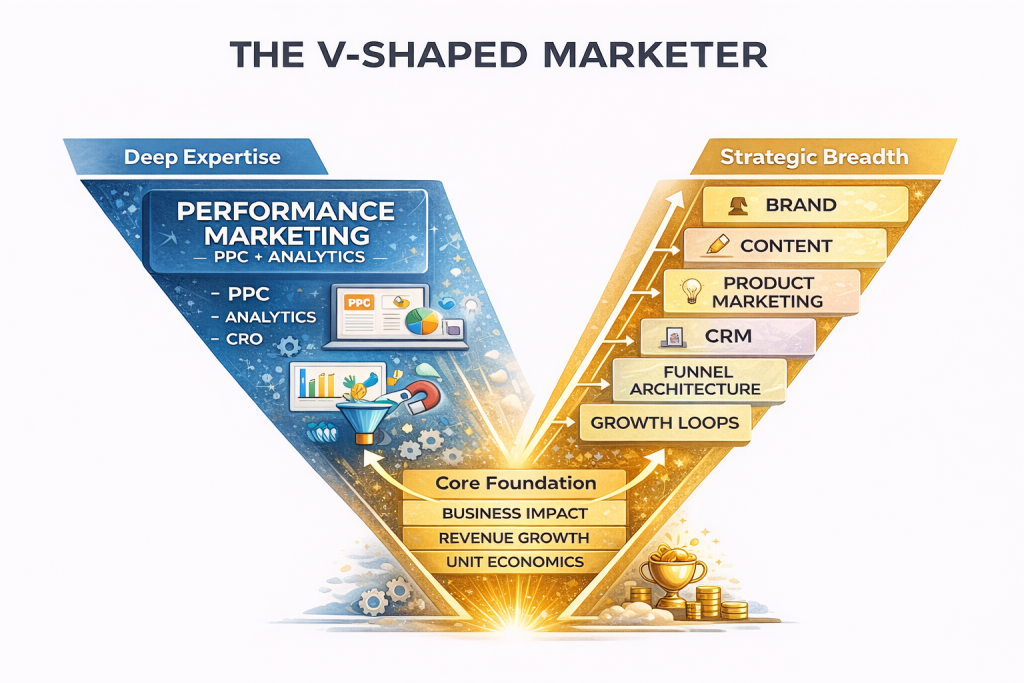
This model reflects a shift toward hybrid complexity.
Why V-Shaped Skills Matter Today
Modern marketing increasingly demands intersections:
- Data + creativity
- Technology + storytelling
- Strategy + execution
Organizations scaling globally cannot rely on one-dimensional expertise. V-shaped marketers can operate across critical nodes of value creation.
Yet there is a practical constraint: maintaining deep expertise in multiple fast-evolving domains is cognitively and professionally demanding. Without continuous upskilling, depth deteriorates.
The X-Shaped Marketer: The Integrator
If T represents breadth plus depth, and V represents multiple depths, then X represents something more structural: connective leadership.
An X-shaped marketer not only understands multiple domains but can:
- Align marketing with product and sales
- Translate between data teams and creative teams
- Lead cross-functional initiatives
- Build shared decision frameworks
In complex organizations, execution bottlenecks rarely arise from lack of knowledge. They arise from misalignment.
The X-shaped professional solves integration friction.
The Real Value of the X-Shape
As organizations mature, coordination becomes more important than specialization. Campaigns fail not because someone lacks tactical knowledge, but because measurement frameworks are misaligned, customer journeys are fragmented, or incentives conflict.
The X-shaped marketer is not simply a more complex T-shaped marketer. They are a systems thinker.
Other Shapes: Expanding the Types
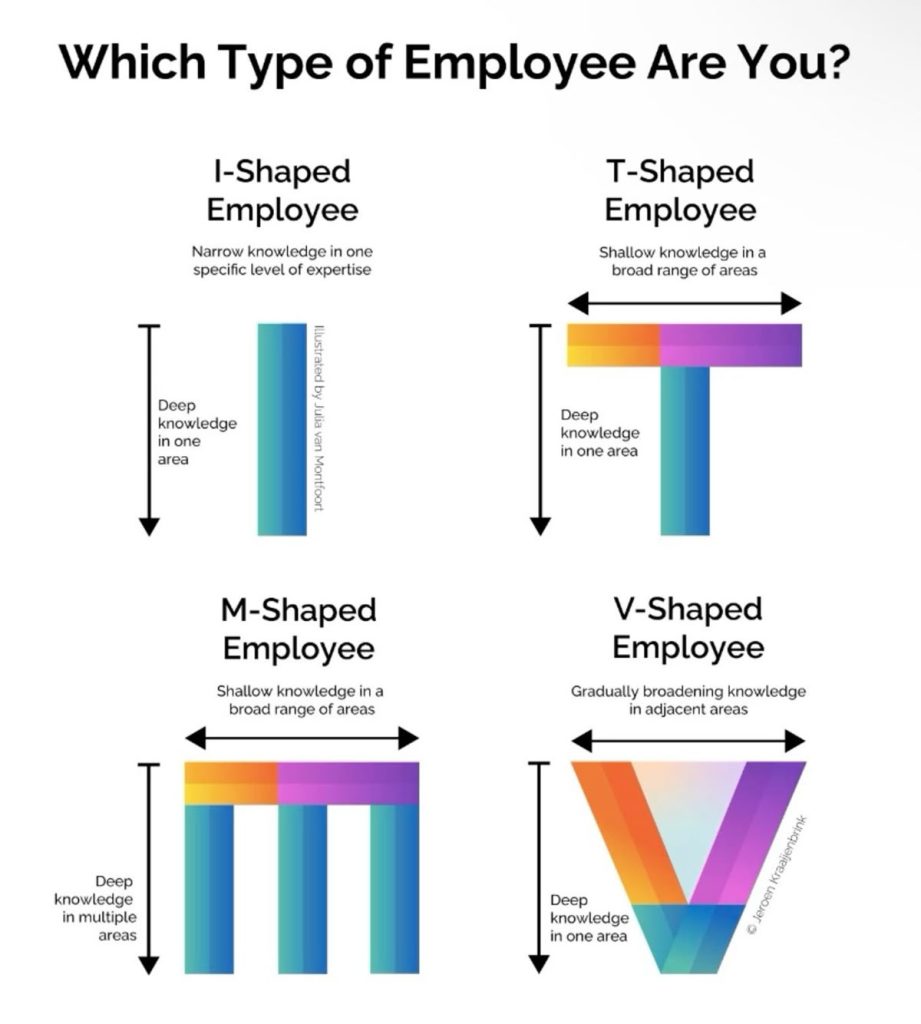
Over time, additional shapes emerged to describe variations:
I-Shaped
Deep specialist, narrow scope. Essential for advanced technical challenges but limited in cross-disciplinary agility.
π (Pi)-Shaped
Two areas of deep expertise are supported by a broad understanding. Increasingly common in growth roles combining analytics and execution.
M-Shaped
Multiple areas of depth. Ambitious but difficult to sustain long-term without support.
Comb-Shaped
Many moderate competencies without extreme depth.
Common in early-stage startups where adaptability outweighs specialization.
Each shape describes how depth is distributed, but none measure capability maturity directly.
The Competency Matrix: Moving Beyond Metaphor
The problem with shape thinking is simplification.
A more rigorous approach is the marketing competency matrix, which maps:
- Marketing domains (strategy, analytics, paid media, brand, CRM, product marketing, automation, UX, experimentation, etc.)
- Proficiency levels (awareness, working knowledge, independent execution, advanced expertise, strategic leadership)
This framework transforms symbolic letters into measurable architecture.
Why the Matrix Matters More
- It reveals capability gaps.
- It supports training roadmaps.
- It informs the hiring strategy.
- It enables team complementarity design.
Instead of asking “Are we hiring a T-shaped marketer?”, the smarter question becomes:
Which domains require depth, and at what proficiency level?
Do Companies Prefer a Certain Specialist Type More Often?
There is no robust global dataset ranking “shape preference” by country to say where and which type is chosen more often. However, workforce research consistently shows demand for hybrid capabilities, cross-functional collaboration, and data literacy.
The implication:
- Startups tend to value T-shaped and Сomb-shaped adaptability.
- Scale-ups increasingly require V-shaped hybrid specialists.
- Enterprises depend heavily on X-shaped integration leaders.
The preference is less geographic and more structural — tied to organizational complexity.
When and Why the Shape Differentiation useful
The differentiation between T, V, and X becomes strategically important in four situations:
- Hiring clarity – Avoid vague role descriptions.
- Team design – Prevent skill redundancy or fragmentation.
- Capability development – Guide upskilling paths.
- Succession planning – Identify future leaders.
When used intentionally, the shapes become design tools.
It exposes capability gaps
If your team is full of I-shaped specialists (deep but siloed), you’ll see coordination issues.
If your team is full of comb-shaped generalists (broad but shallow), you’ll see execution weakness.
The shape conversation becomes a diagnostic tool.
When the differentiation becomes overrated
Where it becomes less important:
- When individuals obsess over labeling themselves.
- When companies use it as a buzzword without mapping real competencies.
- When it replaces structured skill frameworks (like a competency matrix).
In reality, no executive says:
“We only hire V-shaped marketers.”
They say:
“We need someone who can lead cross-channel growth, understand data, and align with product.”
That’s capability language — not shape language.
The Impact of AI on Skill Shapes
Artificial intelligence fundamentally shifts this discussion.
AI reduces the cost of execution depth in many domains. Tactical skills that once required years of specialization are increasingly augmented by tools.
This raises a provocative question:
If AI supports depth, does breadth and integration become the true differentiator?
In many cases, yes.
The marketer of the future may require:
- T-shaped foundational literacy.
- Selective V-depth in high-leverage domains (e.g., analytics, strategy).
- (e.g., analytics, strategy).
- X-shaped connective intelligence for orchestration.
- Systems thinking for automation design.
Shapes begin to overlap.
Conclusions
The most effective marketing organizations do not obsess over letters. They architect capability ecosystems.
And in a world defined by automation, AI, fragmented attention, and accelerating change, adaptability and integration will likely matter more than any geometric metaphor.


No Responses