
Product Market Fit is a state when users like your product and it is definitely needed by the market.
Product-Market Fit is the moment when a product solves such a painful problem that users want to use it themselves, recommend it to others, and are willing to pay. Let’s figure out how to understand whether you have achieved PMF or not yet.
In other words, you don’t need to “persuade” people to use the product – they want it by themselves.
How to achieve Product Market Fit:
- Identify your customers’ needs through market research, interviews, and surveys.
- Make sure the product solves customers’ problems, satisfies their needs, and adds value to their lives.
- Test the product in the market by launching an MVP and collecting customer feedback
- Identify the most effective channels for your target audience and develop a message that resonates with customers.
The term Product-Market Fit in its modern sense was introduced by Marc Andreessen in early 2007. Marc Andreessen is a co-founder of:
- Netscape,
- Andreessen Horowitz (a16z),
one of the most influential venture capitalists in Silicon Valley.
Before him, entrepreneurs talked about this intuitively, through “user needs”, “market demand”, “problem-solution fit” – but without a single term.
The author of the term suggested looking at a startup through three axes – team, product, market. He said:
In the conflict between team, product, and market, the market always wins.
Which means:
- a strong market can “pull out” a weak product and an average team;
- but no team and no product will save a bad or non-existent market.
So the logic looks like this:
- a growing/strong market creates an opportunity for Product Market Fit,
- but Product-Market Fit occurs only when:
A: the product definitely meets the real need of this market,
B: and users confirm this by their behaviour.
A strong or growing market can compensate for an imperfect product and an average team, while no team can create Product-Market Fit in the absence of real demand. At the same time, the market itself does not guarantee Product Market Fit – it only creates the conditions under which the product’s compliance with user needs becomes possible.
It is important to note that even in cases of new market creation – the so-called “Blue Oceans” according to Kim and Mauborn’s theory – Product-Market Fit does not arise in a vacuum. Demand in such markets may be latent or unconscious, so PMF signals appear more slowly and take more time to form user behavioral patterns.
in Blue Ocean:
- PMF does not occur automatically,
- it only appears when:
- the product “turns on” demand,
- users are starting to actively pull solutions.
Examples:
- the first smartphones,
- Uber at its the start,
- Airbnb in the early years of existance.
Examples of brands that found their Product Market Fit
What their founders said, how it felt like
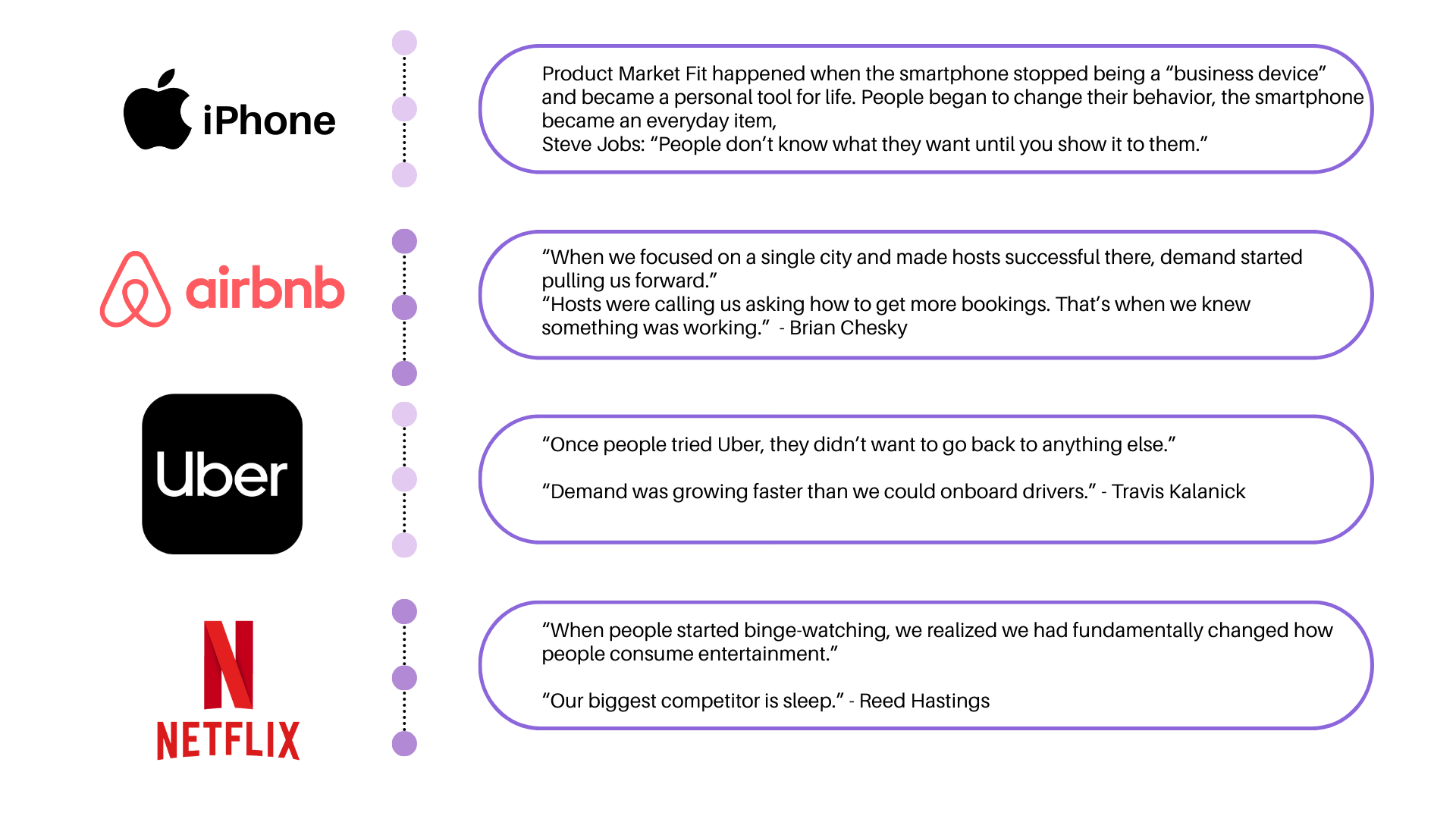
First – weak signals, then – a sharp market pull.
Another important aspect is that it is impossible to assess Product-Market Fit BEFORE launching an MVP.
Product-Market Fit is not about “a good product in a growing market.”
This is about a very specific person who is hurting to live without your solution.
Key signs that Product-Market Fit has been achieved
1. Users consistently receive value and return
Product-Market Fit is manifested not simply in the fact of return, but in the re-obtaining of value.
What to watch:
- retention in a key segment (not across the entire audience),
- Regularity of use, which corresponds to the product core (daily, weekly, event-based). This is calculated by DAU/MAU, which means dividing the number of daily users by the number of monthly users; the higher this indicator, the better.
- maintaining activity without constantly “pushing” users and exponential organic growth, which means that there is a large increase in new users.
Important: For event-based or seasonal products, PMF manifests as a return at the time of need, not as a daily activity.
2. The product clearly addresses a specific problem of a specific segment
Product-Market Fit sign – when the product:
- replaces an existing alternative (another service, Excel, manual process),
- or allows you to do something that was previously difficult or impossible.
The user can clearly explain why they value the product, and this answer is repeated in many interviews.
Phrases like “convenient” or “useful” without specifics usually indicate that the PMF has not yet been formed.
3. A key part of users do not want to lose the product
A useful, but not absolute indicator is the question:
“How would you feel if you could no longer use the product?”
If a significant proportion of active users in the target segment respond “very upset,” this is a strong value signal.
It is important to perceive this indicator as a heuristic that needs to be confirmed:
- real behavior,
- frequency of usage,
- willingness to pay or renew a subscription.
Also helpful will be a metric such as NPS (Net Promoter Score) – it makes it possible to determine the customer loyalty index, which shows whether they are ready to recommend the product to friends.
4. There is a repeated willingness to pay or continue use
PMF almost always manifests itself in financial or contractual behavior:
- subscription renewal,
- repeat purchases,
- upgrades or expansion of use.
Even if the product is free, a sign of PMF will be a conscious return and choice of the product among alternatives.
Words without action are not proof of Product-Market Fit.
5. Growth becomes more predictable, not necessarily viral
PMF does not always mean organic or viral growth.
Instead, it often appears:
- stable conversion in a key segment,
- clear channels of engagement,
- recurring patterns of successful cases.
In B2B this might look like:
- growth of inbound requests,
- simpler sales conversations,
- higher win-rate and expansion among existing customers.
6. The team understands what to scale
One of the underrated traits of PMF is inner clarity:
- clear ICP,
- the core value proposition is comprehensible,
- It is clear which features are critical and which are secondary.
If the team is still arguing about “who our product is really for,” Product Market Fit has most likely not been reached yet.
7. Feedback becomes about “how to do it better”, not “why do it at all”
When PMF appears, the nature of the feedback changes:
- fewer questions “why do I need this?”,
- more requests for improvements, integrations, scaling.
This means that the value has already been accepted and users invested into the future of the product.
Brief conclusion
Product-Market Fit is not a single signal, but a set of behavioral, qualitative and business indicators. The biggest mistake is to look for one “magic” indicator instead of a systemic picture.


No Responses