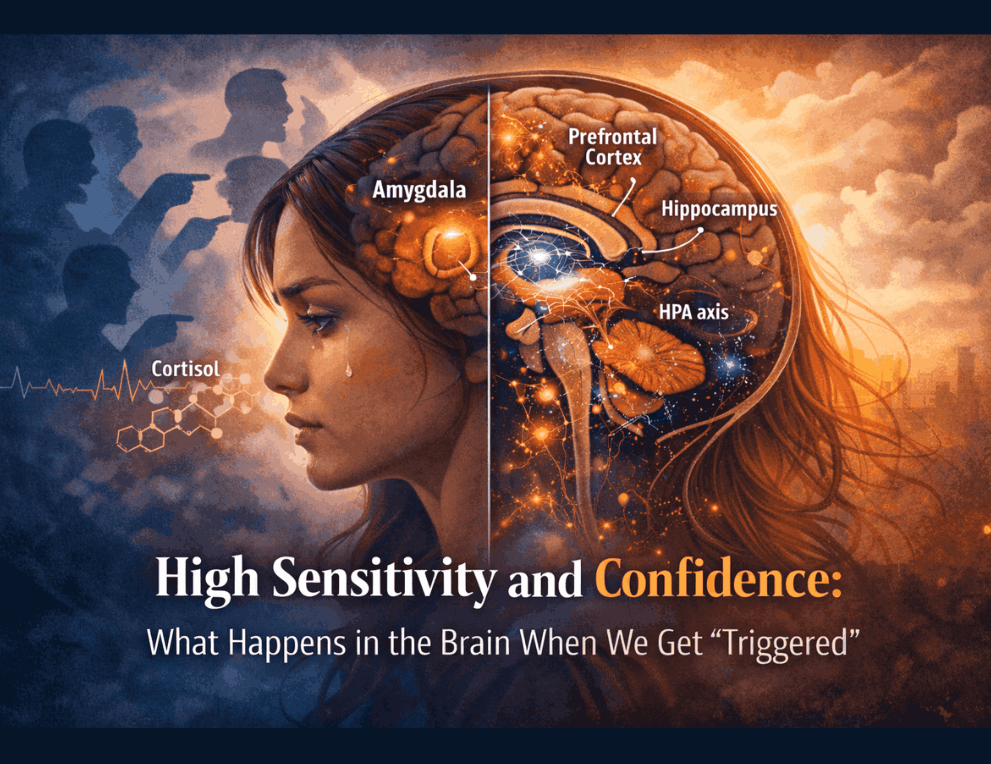
Everyone knows this experience: someone says something harsh and you seem to freeze. The answer comes later. The internal monologue begins: “Why didn’t I say anything?”, “Why am I so confused?”.
From the outside, this is often explained by a lack of confidence. But the study of modern neuroscience shows that at such moments we are not faced with a “weak character”, but with the work of the threat system, which is activated in the brain. And highly sensitive people (HSP) have its own characteristics of this system, it is worth noting that about 15-20% (according to some studies up to 30%) of the world’s population is highly sensitive.
In this article we will look at:
- what happens in the brain during a sudden social threat;
- what does “deeper stimulus processing” mean in a scientific sense;
- Are highly sensitive people really less confident?
- how confidence is formed at the level of neural connections;
- and why allowing yourself for error actually changes the physiology of stress.
Social threat is not a “trifle” for the brain
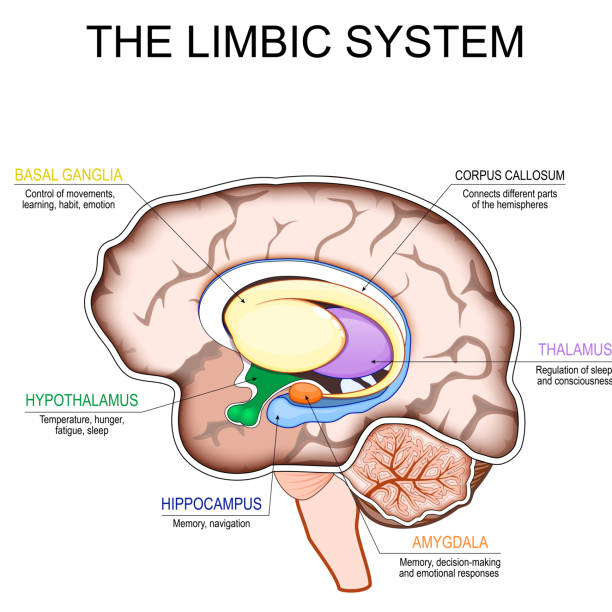
When we receive a harsh remark or face a , the first to react is the Amygdala, a structure of the limbic system responsible for recognizing threat.
The brain doesn’t really distinguish between:
- physical danger
- social rejection
Social threats include: quarrel, conflict, rejection, devaluation, humiliation, intrusion without consent, crossing boundaries, imposing advice, sarcasm, public criticism, ridicule, pressure, double standards, undermining authority, public “devaluation of competence”, sharp mood swings of the partner, unstable, the CEO’s reaction, inconsistency, etc.
This is not a metaphor. In 2003, Naomi Eisenberger and Matthew Lieberman (UCLA) conducted a famous study called Cyberball. Participants were “excluded” from a virtual game, it was a form of social rejection. The brain scans showed activation in the following areas:
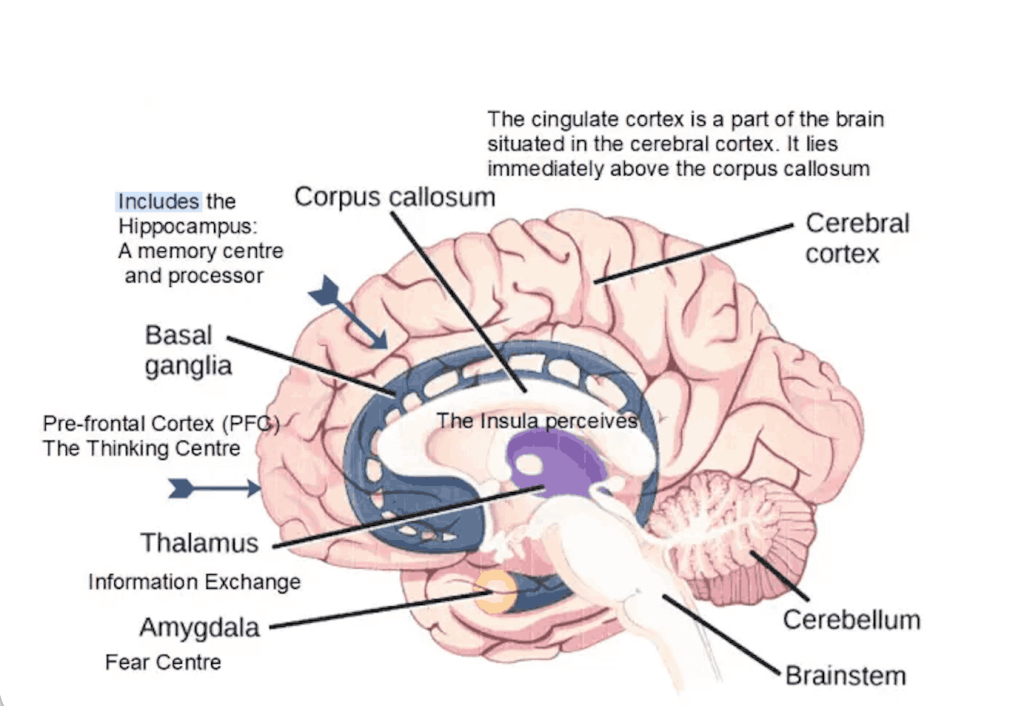
- Anterior cingulate cortex
- insular cortex
These same areas are activated during physical pain.
Below are images of the brain parts to further reveal what everything looks like:
In other words, for the brain, a harsh phrase told you by someone is also an event of biological significance that triggers a whole chain of reactions within the brain.

Why does the head “turn off” at that moment?
After activation of the amygdala, a stress response is triggered:
- cortisol increases
- the sympathetic nervous system is activated
- the body goes into “fight/flight/freeze” mode
The brain also contains the Hippocampus , which is responsible for:
- memory consolidation, especially responsible for long-term memory
- context
- distinction between “now” and “then”
- inhibition of the stress response
And here’s the key point: The hippocampus has a lot of receptors for cortisol.
That’s why:
- short-term stress → temporary memory impairment
- chronic high cortisol → structural changes
Therefore, it turns out that during acute stress, the activity of the Prefrontal Cortex, the area responsible for:
- speech ability
- logic
- cognitive flexibility
- formulating answers
When cortisol is high: - the hippocampus works worse
- working memory deteriorates
- harder to remember words
- more difficult to formulate thoughts
Here’s why during conflict people may: - forget the arguments
- not to mention the facts
- “to lose one’s train of thought”
- This is not a weakness – it’s biochemistry.
Neurobiologist Amy Arnsten (2009) described how stress literally “turns off” prefrontal functions, transferring control to more primitive brain structures.
Therefore, something like stupor is not a sign of weakness. It is a natural reaction of the nervous system.
Chronic stress can cause structural changes, including a reduction in hippocampal volume, which has been described during research of people with PTSD. During research of people with PTSD (post-traumatic stress disorder) it have been found: impaired functioning of hippocamp; reduction in hippocampal volume. Some of the changes can be reversed with therapy and stress reduction, but not much, as this process is mostly irreversible.

What is the peculiarity of highly sensitive people in stress reactions?
The term Sensory Processing Sensitivity (SPS) was proposed by Elaine Aron. It is not a disorder, but a temperamental trait, inherent in approximately every 5-6th person, as indicated above.
Research using tomography (fMRI)
In 2014, a study was published in the journal Brain and Behavior, which showed that people with high SPS have more active:
- insula
- areas associated with empathy
- areas responsible for deep cognitive processing
This means that “deeper processing of stimuli” is not a metaphor, but a measurable phenomenon.
The insula is the center of interoception, that is, the ability to sense the internal state of the body: heartbeat, chest tightness, tightness in the throat, nausea, “stomach knots,” heat/cold, internal shivering.
The insula essentially answers the question, “What’s happening inside me right now?”
When people:
- experiencing social rejection
- feel ashamed
- look at the suffering of others
- feel empathy
the insula is activated.
Therefore, it is considered a key structure for emotional awareness, empathy, and social sensitivity. And it often works more intensely in highly sensitive people.
What does “deeper processing” of stimuli in the brain mean in practice?
Relatively speaking, a stimulus in the HSP brain undergoes more levels of analysis:
- Sensor signal
- Threat assessment
- Context analysis
- Comparison with past experience
- Emotional integration
- Forecast of consequences
All of that gives:
- higher empathy
- more accurate reading of nuances
- deeper understanding of situations
But at the same time:
- slower instant reaction
- greater risk of overload
Human confidence: what psychology and neuroscience say
Psychologist Albert Bandura introduced the concept of self-efficacy — a person’s belief in their own ability to cope with a situation.
Research shows that people with high self-efficacy:
- have a lower cortisol response
- recover faster from stress
- demonstrate better emotional regulation
Important: Confidence does not mean the absence of fear. It means the expectation that fear will not destroy.
Neurobiologically, this looks like a stronger connection between the prefrontal cortex and the amygdala. The threat signal is there, but it is regulated more quickly.
Can highly sensitive people be confident?
Yes. And here it is important to distinguish:
- start of reaction
- reaction finish
High sensitivity affects the start – the depth and intensity of the initial processing.
Confidence affects the finish — the speed of recovery and the transition to action.
A person can:
- feel strong activation
- notice all the nuances
- and at the same time have an inner “I can handle it”
This is not a contradiction. This is integration.
Shame, guilt and the duration of stress
Shame often sets in after a failed response.
Neuroimaging studies show that experiencing shame is associated with activation of the insula and the social pain network.
The longer a person is in shame, the longer the threat system is active.
At the same time, Kristin Neff’s research on self-compassion shows:
- decreased cortisol
- reducing the duration of the stress response
- increasing psychological resilience
When a person allows themselves to make mistakes and does not identify the mistake with their value, they actually change the biochemistry of recovery.
Can resilience be “trained”?
Yes, but not by suppressing sensitivity.
Trained:
- Activation tolerance
- Behavioral experience “I survived and did not collapse”
- Reducing secondary shame
- Formation of cognitive anchors
Every experience in which a person:
- speaks in front of people despite fear
- speaks despite trembling
- makes mistakes and remains whole
This all changes its expectation system. The brain learns: activation ≠ danger, at least not always.
Conclusion
Neuroscience shows:
- Social threat is a real biological trigger.
- A reaction similar to stupor or freezing is a consequence of a temporary decrease in the activity of the prefrontal cortex.
- High sensitivity is deeper, not weaker, information processing.
- Confidence is a trained expectation of one’s own resilience.
- Allowing for a mistake reduces the duration of stress.
So, being highly sensitive doesn’t mean being insecure.
Being confident doesn’t mean not feeling.
True psychological resilience is not the absence of reaction.
This is the ability to return to oneself more quickly.
And this is a skill that can be developed — not against your nervous system, but together with it.


No Responses